
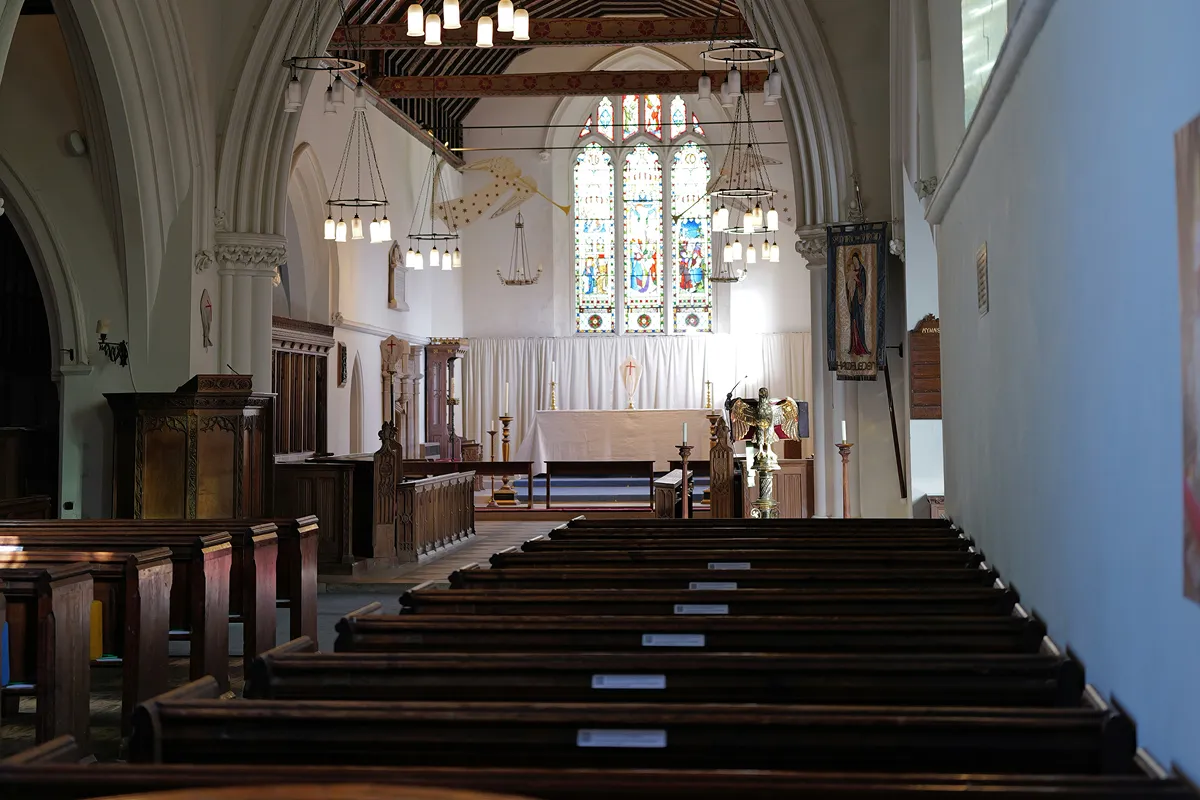
Communion: Does your church partake?
Good day to each of you reading this column on communion in the church.
Before we begin, let’s turn to some humor from South County Churches :
Pastor Dave Charlton tells us, “After a worship service at First Baptist Church in Newcastle, Kentucky, a mother with a fidgety seven-year-old boy told me how she finally got her son to sit still and be quiet.
About halfway through the sermon, she leaned over and whispered, ‘If you don’t be quiet, Pastor Charlton is going to lose his place and will have to start his sermon all over again!’ It worked.”
A little girl was sitting on her grandfather’s lap as he read her a bedtime story. From time to time, she would take her eyes off the book and reach up to touch his wrinkled cheek. She was alternately stroking her own cheek and then his again.
Finally, she spoke up, “Grandpa, did God make you?”
“Yes, sweetheart,” he answered. “God made me a long time ago.”
“Oh,” she paused, “Grandpa, did God make me too?”
“Yes, indeed, honey,” he said. “God made you just a little while ago.”
Feeling their respective faces again, she observed, “God’s getting better at it, isn’t He?”
Finding one of her students making faces at others on the playground, Ms. Smith stopped to gently reprove the child.
Smiling sweetly, the Sunday school teacher said, “Bobby, when I was a child, I was told that if I made ugly faces, it would freeze and I would stay like that.”
Bobby looked up and replied, “Well, Ms. Smith, you can’t say you weren’t warned.”
A wife invited some people to dinner. At the table, she turned to their six-year-old daughter and said, “Would you like to say the blessing?”
“I wouldn’t know what to say,” the girl replied.
“Just say what you hear Mommy say,” the wife answered.
The daughter bowed her head and said, “Lord, why on earth did I invite all these people to dinner?”
An exasperated mother, whose son was always getting into mischief, finally asked him, “How do you expect to get into Heaven?”
The boy thought it over and said, “Well, I’ll run in and out and in and out and keep slamming the door until St. Peter says, ‘For Heaven’s sake, Jimmy, come in or stay out!’”
A minister told his congregation, “Next week I plan to preach about the sin of lying. To help you understand my sermon, I want you all to read Mark 17.”
The following Sunday, as he prepared to deliver his sermon, the minister asked for a show of hands. He wanted to know how many had read Mark 17. Several hands went up.
The minister smiled and said, “Mark has only sixteen chapters. I will now proceed with my sermon on the sin of lying.”
Well, there you have more good jokes and a big thanks from south county churches .com
Before we begin, each of you know that elections begin in just a few days, so have you voted? If so great and if not, get out and vote, but vote for someone who has Christian values. I challenge all so many Christians who just sit on the fence. Folks, the time is short so vote, pray, and humble yourselves before the Lord and as the Bible says—Come so very quickly, Lord Jesus.
As I have been reading 1 Corinthians, I came upon the subject of communion and thought I would ask the following:
Does your church practice communion?
If so, how many times in a year?
Is it once a month, once a quarter, every six months, once a year?
Do you think small children such as under 10 understand in partaking of communion?
Do you, as an adult, partake in communion, no matter what and is their something in the Bible that would make you think twice?
Why do you take communion and is it a ritual?
So, I went to AI and found some very interesting information:
No. Most Christian churches practice communion in some form, but a few—most notably Quakers and The Salvation Army—do not observe it at all, while others vary widely in frequency and eligibility requirements.
Overview
Communion (also called the Lord’s Supper or Eucharist) is practiced by the vast majority of Christian denominations, but not universally. Practices differ in theology, frequency, and who may participate.
Churches That Do Not Take Communion
- Quakers (Religious Society of Friends): They do not practice communion because they view all of life as sacramental and believe rituals may distract from direct experience of God.
- The Salvation Army: They do not offer communion, partly due to their historical ministry to people struggling with alcoholism and their view that communion is non-essential.
Churches That Take Communion Regularly
- Liturgical churches (e.g., Roman Catholic, Eastern Orthodox, Episcopal):
These typically celebrate communion every week, often at every service. - Some non‑liturgical churches (e.g., Christian Church/Disciples of Christ, Churches of Christ):
These also practice weekly communion.
Churches With Flexible or Occasional Communion
- United Methodist Church: Frequency is determined by the congregation; communion may be celebrated as often as desired.
- Christian Reformed Church: Requires communion at least four times per year.
- International Pentecostal Holiness Church: Requires at least once per year.
Differences in Who May Receive Communion
- Closed communion: Some churches (e.g., Roman Catholic) restrict communion to members in good standing of their own tradition.
- Open communion: Many Protestant churches allow all Christians who profess faith to participate.
Summary
While communion is a central practice for most Christian denominations, a small number do not observe it, and those that do vary significantly in frequency and participation rules.
Before we get into the lesson, turn to I Corinthians 11: 17-34 as this will be the basis of the column. I hope you read this passage for I will use it in answering various questions.
Does your church practice communion? We have been attending a Methodist (not United) church which partakes in communion once a month. As you read above, various churches practice communion once a week, a month or around Christmas and two organizations do not partake at all.
If so, how many times in a year? This depends on the church and the pastor. If you are not in a church that participates in communion, then ask why? Why aren’t you enjoying the Lord’s Supper and the meaning by it. The Lord’s Supper is the remembrance of Jesus, the cup is the new covenant in Jesus’s blood as you drink, you are to remember Jesus. As for the bread, this is Jesus body, so take and eat and do this in remembrance of Jesus.
The conclusion is found in verse 26: For whenever you eat this bread and drink this cup, you proclaim the Lord’s death until he comes.
The Last Supper is recorded in the following books, Matthew 26:20-30, Mark 14:17-26, Luke 22: 14-22 & John 13:21-30. As noted, the Passover in Luke 22:14-18, commemorated Israel’s escape when the blood of the lamb painted on the doorframes saved their firstborn sons from death. This event foreshadowed Jesus’ work on the cross. As the spotless Lamb of God, his blood would be spilled in order to save his people from the penalty of death brought by sin.
If your church is not providing communion, then you need to have a meeting with the pastor and find out why? Jesus is the lamb of God who taketh away the sin of the world and we are to celebrate this by communion.
As you read verses 17-34, you could summarize these verses as saying that the Lord’s Supper visually represents not just the death of Jesus, but that we know he will return and this belief when we participate in communion is with both Jesus and with his fellow believers.
When I referred to Luke 22:13-20, I noted that Jesus had the Lord’s Supper on the night of the Passover, this was not by coincidence for the Passover celebrated Israel’s deliverance from slavery in Egypt, so we, as Christians, celebrate Jesus’ death as deliverance from sin and death.
As you read verse 25, take notice of the new covenant—remember that the Israelites were under the Old Covenant where the Israelites could approach God only through priests and sacrificing animals. The Old Testament was established in Exodus 24 between the Israelites and God. As for the New Covenant, God completes, rather than replacing the Old Covenant, by fulfilling what Jeremiah 31:31-34 says:
31 “The days are coming,” declares the Lord,
“when I will make a new covenant
with the people of Israel
and with the people of Judah.
32 It will not be like the covenant
I made with their ancestors
when I took them by the hand
to lead them out of Egypt,
because they broke my covenant,
though I was a husband to[a] them,[b]”
declares the Lord.
33 “This is the covenant I will make with the people of Israel
after that time,” declares the Lord.
“I will put my law in their minds
and write it on their hearts.
I will be their God,
and they will be my people.
34 No longer will they teach their neighbor,
or say to one another, ‘Know the Lord,’
because they will all know me,
from the least of them to the greatest,”
declares the Lord.
“For I will forgive their wickedness
and will remember their sins no more.”
The Israelites broke their covenant with God by committing adultery and going after false gods. Jesus represents the new covenant for all people. The New Covenant gives all of us the opportunity to establish a permanent and personal relationship with God.
Look no further than Hebrews 8:6 (NIV) 6 But in fact the ministry Jesus has received is as superior to theirs as the covenant of which he is mediator is superior to the old one, since the new covenant is established on better promises.
It is so wonderful to know that all people can approach God directly and prayerfully communicate with him 24 hours per day on any and all things.
We don’t need a priest, a go-between, or an intermediary, we can go directly to God.
Do you think small children such as under 10 understand in partaking of communion? I have researched the Bible and nowhere does it give an age as to when a person can take communion. Since this is a parent’s decision it is essential that the child understands why he or she is taking communion. Paul, in verse 27, brings forth the following: 27 So then, whoever eats the bread or drinks the cup of the Lord in an unworthy manner will be guilty of sinning against the body and blood of the Lord.
Can your child explain to you, the parent, why he or she takes communion? Do they make the excuse that they see their parents doing it, or that they can get a snack? Are you as a parent promoting an unworthy manner? Does your child understand and comprehend why communion is between you and God? If you have doubts, then don’t have your child involved in communion.
Do you, as an adult, partake in communion, no matter what and is there something in the Bible that would make you think twice?
Here are some questions that you can answer personally before taking communion:
Do you take the Lord’s supper thoughtfully and the proclamation that Jesus’ died for our sins?
Are you taking the Lord’s Supper virtuously, with both due reverence and respect?
Have you examined yourself and repented on any unconfessed sin or resentful attitude?
Are you prepared mentally to take the Lord’s supper with a humbled heart?
Communion is serious—this is not a snack or a place to get a piece of bread and cup of juice for this is the Lord’s supper. As you prepare your heart and mind, be very aware that you are partaking in what Jesus’ did and why he did it.
The significance is simple, this is not a ritual or a pious habit and if it has become that, then get on your knees and ask for forgiveness.
Communion or the Lord’s Supper is so personal because Jesus is with you along with other believers in the participation for whenever you eat this bread and drink this cup, you proclaim the Lord’s death until he comes.
Are we worthy of taking the Lord’s supper? No, as we are all sinners saved by grace. Prepare your heart and mind before the Lord and humble yourself in his presence.


