

No Debt, No Chains
Good day to each of you reading this column for this is Easter and the Lord has risen! Hooray! I do feel sorry for you folks who believe that death is the end all and there would be no eternal life.
I am a Christian and I know when I die that I will be in the kingdom for eternity and this is my hope for my family, friends and fellow Christians.
I was reading an article on our current state of affairs in the world and how debt has affected our country. Take a moment to review the following:
As of 2025, American households carry significant debt, averaging $105,056 per household. This total debt has reached an all-time high of approximately $18.8 trillion.
Debt Breakdown by Type
- Credit Cards: Average balances vary significantly by age group, with younger generations typically holding more credit card debt.
- Mortgages: The majority of household debt is tied to mortgages, reflecting the high cost of housing.
- Auto Loans: Many Americans also carry substantial auto loan debt, contributing to overall financial obligations.
Demographics of Debt
- Debt levels differ by age, income, and education, with younger individuals often facing higher debt-to-income ratios.
- As of late 2025, the average adult in the U.S. owed around $63,300.
Overall, these statistics highlight the growing financial pressures faced by American households, influenced by various factors including economic conditions and consumer behavior.
America, you have become cursed in the city and cursed in the country for instead of lending to many nations you borrow from many nations. Deuteronomy 28:17-18 (NIV) says Your basket and your kneading trough will be cursed. The fruit of your womb will be cursed, and the crops of your land, and the calves of your herds and the lambs of your flocks.
America, land of the free and home of the brave has turned its head from God and is now receiving the curses, but all so many Christians have turned their heads to those both blessings and curses found in Deuteronomy 28.
This country has been blessed so greatly with so many natural resources, rich and fertile land, lots of livestock and as Abraham Lincoln said, that this nation, under God, shall have a new birth of freedom – and that government of the people, by the people, for the people, shall not perish from the earth.
Debt will not perish when we don’t listen to what the Bible says and follow God’s commandments, statutes and ordinances.
If we would only take the time to read the Bible for this would give us the blueprint as for the blessings for Obedience and the curses for Disobedience.
But you see the apple does not fall from the tree for debt is the king of our government. What an example to the world, instead of being the head, America is now the tail and this is where I want to show you what will happen next and what America will experience.
Here is a quote from Canadian Prime Minister Mark Carney at the World Economic Forum in Davos on January 20 which says great powers have begun using economic integration as weapons, tariffs as leverage, financial infrastructure as coercion, and supply chains as vulnerabilities to be exploited.
Look at what George Sarvelos, Deutsche Bank’s head of global currency said, “For all its military and economic strength, the U.S. has one key weakness: It relies on others to pay its bills via large external deficits.”
President Trump continues to use the tariffs as a weapon against the very countries that buy America’s debt. Now to add fire to the furnace, the President threatens trade wars with the world and here is what could very well happen and bring America to its knees.
Again, George Saravelos wrote, “It is a weaponization of capital rather than trade flows that would by far be the most disruptive to markets.” Yes, Europe could fight Trump’s tariffs by levying their own tariffs. Instead, as Saravelos suggested: Refuse to loan America money, and the U.S. will be brought to its knees.
Let’s put America debt into perspective per Economics Insider.
The United States continues to hold the largest national debt in the world, which has surpassed $38 trillion. A major portion of this debt is funded through U.S. Treasury securities, which are bought by foreign governments and investors. Among the largest US Treasury holders, Japan leads the list, followed by the United Kingdom and China. Japan remains the largest holder of U.S. Treasuries with $1.18 trillion, up from $1.095 trillion a year earlier. Additionally, China’s treasury holdings remain at $700 billion, compared to $772 billion one year ago.
The United Kingdom is steadily increasing its US Treasury holdings and currently holds $865 billion, which is about 13% higher than the $769 billion it held a year ago. The top five countries together hold about $3.69 trillion in US Treasury securities. Among them, only China reduced its holdings compared to last year, while the other four countries increased theirs.
Key Takeaways
- The top 15 largest US Treasury holders collectively own approximately $6.7 trillion in U.S. securities in 2025.
- Japan remains the top holder, with $1.18 trillion, followed by the United Kingdom and China.
- Treasury securities are the primary way the U.S. government borrows from foreign countries and investors to finance its debt.
What Are Treasury Securities and How Do They Work?
Why do countries invest in U.S. Treasuries, and what does this mean for the U.S. economy? Treasury securities are U.S. government-issued debt instruments that are often purchased by foreign governments and investors to earn interest over time. They are a type of safe interest-bearing asset backed by the U.S. government. The U.S. government uses these securities to fund it’s public spending related to defense, healthcare, and infrastructure. The trust in these instruments helps the U.S. borrow at low interest rates, even while carrying massive debt.
The Largest US Treasury Holders in 2025
The list of the largest US Treasury holders is dominated by major global economies. The table below shows the top countries with the largest holdings of U.S. Treasury securities in 2025.
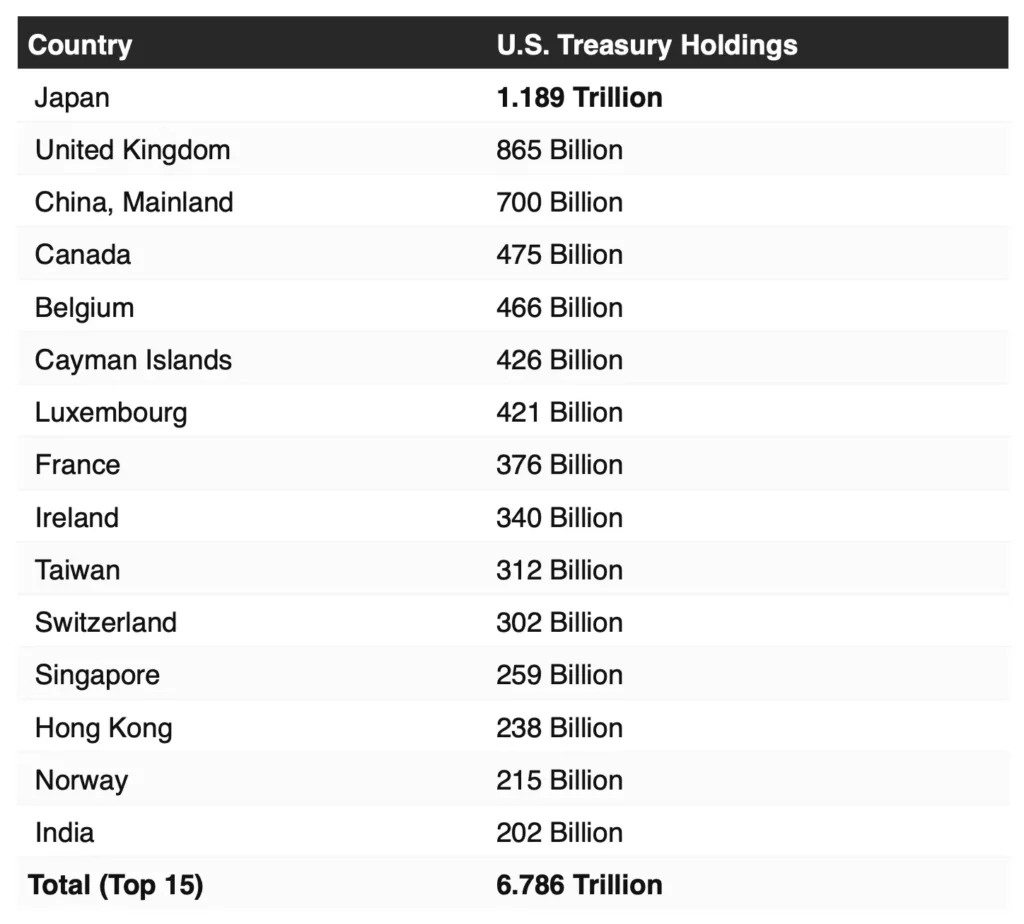
The data is sourced from the U.S. Departmentof the Treasury.
Top Foreign Holders of U.S. Treasury Securities
These countries account for the majority of foreign-held U.S. debt and play a significant role in global finance.
Japan
Japan holds the massive $1.18 trillion in US treasury assets, which ranks it at the top spot among the largest US Treasury holders. The country’s holdings of U.S. Treasuries increased by about 8.6%, rising from $1.095 trillion in September 2024 to $1.189 trillion in September 2025. Therefore, Japan still maintains the top position globally. Japan’s central bank and institutional investors purchase the U.S. treasuries to help manage the exchange rate and maintain stable foreign reserves.
United Kingdom
The UK is a major global investor and holds a massive $865 billion of US treasury securities. This marks an increase from $769 billion in the previous year. The country is continuously increasing its U.S. Treasury securities. Additionally, the UK’s position among the largest US Treasury holders shows its stable financial system and strategic investments in U.S. markets.
China
China is the third-largest holder of US treasuries after Japan and the United Kingdom. The country holds $700 billion in US Treasuries in 2025, which is a slight decrease of 9.2% from $772 billion a year earlier. U.S.–China relations have remained strained amid ongoing trade tensions and economic rivalry. Recently, the U.S. has imposed tariffs of up to 145% on Chinese imports, while China responded with 125% tariffs on American goods. These rising trade tensions may influence how China manages its U.S. bond holdings in the future.
China has already been reducing its U.S. Treasury holdings over the years. From a peak of around $1.3 trillion in 2013, its US treasury bond holdings have declined to approximately $700 billion in 2025.
U.S. vs. China: GDP Output Comparison from 2014 to 2025
Cayman Islands
With $426 billion in holdings, the Cayman Islands is the fourth largest holder of U.S. Treasury securities. It is a major offshore financial center located in the western Caribbean Sea. This major holding is largely due to hedge funds and private financial institutions operating through Cayman-based structures. Additionally, the country’s holdings have slightly increased from $424 billion a year ago to $426 billion in 2025.
Belgium
Belgium holds $466 billion in U.S. Treasury securities in 2025, which is a 27% increase from $366 billion in 2024. This is a big increase, which shows that Belgium has added more to its US debt holdings in just one year. One reason for this massive rise is that the US Treasuries are seen as a safe and stable investment, especially during uncertain times.
Luxembourg
Luxembourg is a major European financial hub, with around 25% of its GDP coming from the financial sector. The country holds the fifth largest $421 billion in U.S. Treasuries, up from $407 billion in 2024. Luxembourg is also among the wealthiest nations in the world due to its GDP per capita, which currently ranks as the highest globally. Additionally, it is home to over 120 international banks and numerous investment funds.
Several other countries also hold significant amounts of U.S. Treasury securities, including Canada, Belgium, France, and Ireland. Canada holds $475 billion, which reflects its strong economic ties with the United States.
Ireland stands at $340 billion, while Taiwan and Switzerland hold $312 billion and $302 billion, respectively. Hong Kong and Singapore follow closely with $238 billion and $259 billion, respectively. Even India and Brazil, two growing economies, maintain massive holdings of U.S. securities at $202 billion and $172 billion, respectively.
Conclusion
Collectively the top 15 countries hold a combined approximately $6.7 trillion in U.S. Treasury securities in 2025. Japan alone holds more than $1 trillion of US treasury bonds, followed by the United Kingdom and China. The U.S. uses these securities as a way to borrow money to finance its national debt. By selling Treasury bonds to foreign countries and investors, the government raises funds to cover budget deficits and finance various public projects.
The United States continues to hold the largest national debt in the world, which has surpassed $38 trillion, so what would happen if Japan, China, Belgium and Canada do what Denmark did when President Trump threatened to take Greenland from Denmark? Denmark said it would sell its U.S. treasury bonds and what would happen if the above countries followed that course of action.
Demand would plummet and our U.S. Treasury would be forced to offer even higher rates to any country willing to buy American debt and if they did not, then the American economic system would come at a catastrophic crash.
Another bit of information is that in December, the Wall Street Journal reported that European officials are privately discussing a coordinating dump of U.S. treasury bonds to cripple the US economy while minimizing damage to both Europe and other economies.
Don’t you find it interesting that both Russia & Germany are not mentioned in the purchases of U.S. debt for the United States was the most influential country in the re-building of their countries after World War 2. Both these countries will figure prominently in prophecy as we will explore Bible prophecy on both countries.
How much money did the U.S. borrow in new debt in 2025? According to the AI overview:
The U.S. government added approximately $2.2 trillion to $2.23 trillion in new gross national debt during fiscal year 2025, bringing the total debt to over $37.6 trillion by October 2025. The federal budget deficit for FY2025 was $1.8 trillion.
Key facts about the 2025 borrowing include:
- Total Debt Level: The gross national debt surpassed $38 trillion during the year, reaching $38.40 trillion by early December 2025.
- Daily Borrowing: The U.S. was borrowing roughly $6.12 billion to $7 billion per day.
- Debt Drivers: Significant drivers of this increase included interest payments on existing debt, which exceeded $1 trillion for the first time.
- Net New Legislative Debt: Lawmakers added $1.5 trillion in net new ten-year debt through policy actions in 2025.
The Treasury Department confirmed that the total debt increased by $2.17 trillion, with $1.97 trillion held by the public.
Let’s put this into perspective, if every bit of goods and services that were produced by the U.S. economy—for example, the money from every car made, haircut given, or meal served, then added together, would barely pay off the old debts that had to be repaid in 2025 and cover the new borrowing.
Take a moment and review the USA debt to GDP from other countries per https://ucbbank.com/plan/wealth-management-library/investment-planning/national-debt-around-world
National Debt, Around the World
The U.S. national debt stood at $31.4 trillion before the Congress acted with legislation to avoid a default on the debt. That number is so huge that it is hard to comprehend. An easier way to think about it is to compare the debt to the economy that must support it. The International Monetary Fund has provided the data on the debts of nations over time, which is quite interesting (see International Monetary Fund).
In 1950 the U.S. national debt amounted to 78.2% of the nation’s Gross Domestic Product (GDP). The very high costs of World War II were still being paid down. The debt declined over time, reaching 27.51% of GDP in 1974, the modern low point. It rose slowly, reaching 57.39% of GDP in 1993, at the beginning of the Clinton administration. Through a combination of spending control and increased tax revenue, the debt fell to 41.38% of GDP by the end of the Clinton years.
Interestingly, the war on terror after 9/11 was not accompanied by a major increase in the national debt, in terms of the GDP, despite increased military spending. In 2007, it was still only 45.17% of GDP. The onset of the Great Recession in 2008 marked a dramatic change, as the debt grew steadily faster than the economy as a whole through 2019, when it reached 93.11% of GDP. Then we had the pandemic, and massive government spending offset the economic effects that ensued. In 2020, we reached the modern high of 119.37% of GDP, before dipping to 115.28% in 2021 (latest data available).
When interest rates are low, the cost of paying the interest on the national debt is also low. However, as interest rates have risen to put a damper on inflation, the cost of debt service has risen as well, now coming to roughly the same as the amount spent on the defense department. As rates go higher, the problem that Congress will have to wrestle with is whether other discretionary spending will be crowded out.
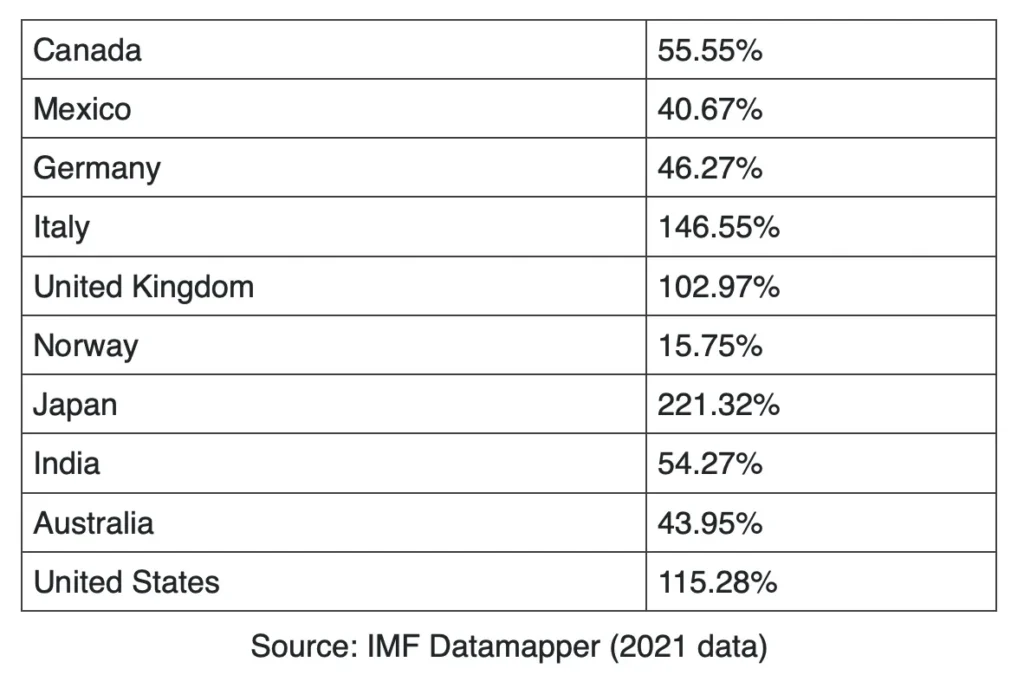
The U.S.A. is far from having the highest national debt as a percentage of GDP in the world, but we are in the top tier. For example, Japan’s national debt comes to 221.32% of its GDP! In contrast, Germany’s debt is 46.27% of its GDP, Sweden’s is 39.31%, and Norway just 15.75%. The table below reports the national debts of several other countries.
Country by country, national debt as a percentage of GDP
So what is GDP, according to AI overview:
Gross Domestic Product (GDP) is the total market value of all final goods and services produced within a country’s borders in a specific time period, acting as a primary indicator of economic health. It measures economic activity, growth, and size using production, expenditure, or income methods. Key types include nominal GDP (current prices) and real GDP (inflation-adjusted).
Key Aspects and Usage Examples of GDP
- Economic Health Gauge: Policymakers and investors use GDP to determine if the economy is expanding or contracting.
- Performance Monitoring: The growth rate, typically calculated using real GDP to remove inflation distortions, tells if an economy is growing too fast (risk of overheating) or too slow (potential recession)
- International Comparisons: GDP per capita is used to compare the relative performance and standard of living between different nations.
- Formula (Expenditure Approach):
- C (Consumption): Household spending.
- I (Investment): Business spending on equipment/capital.
- G (Government Spending): Public sector spending.
- X-M (Net Exports): Exports minus imports.
Synonyms and Related Terms
- Economic Output: Refers to the total volume of goods and services produced.
- National Income: Related to the total income earned through production.
- Nominal GDP: GDP at current prices.
- Real GDP: Inflation-adjusted GDP.
- GDP at Factor Cost: Total value added by economic activities (excluding taxes/subsidies).
According to various sources, the International Monetary Fund generally considers any figure above 20% to be risky as the U.S. government received 5.2 trillion in revenue last year and without the ability to borrow tens of trillions a year, the U.S. government would go bankrupt very abruptly.
As I have spoken in the past, when America broke God’s laws on usury and debt, then God’s people must pay the price of disobedience.
How can God bless America when Christians turn from the Bible and break the rules of Divine economics? God wants each of us to be prosperous and not under the bondage of the current economic system but we are stiff-necked and not willing to follow the very statement that are foretold in both the Old and New Testament.
The present economic will crumble and fall for this system is built on sand. Look at Ezekiel 7:19 (NIV) “‘They will throw their silver into the streets, and their gold will be treated as a thing unclean.Their silver and gold will not be able to deliver them in the day of the Lord’s wrath. It will not satisfy their hunger or fill their stomachs, for it has caused them to stumble into sin.
Debt, both personally and by the government are chains around all so many Americans. If America had no debt, there would be no inflation and the dollar would go so much further will your purchasing power, but the weights and scales are not balanced thus creating America to be the tail and not the head.
I urge each of you to get out of debt and be the head and not the tail for when you do, you will feel those chains of debt fall off of you.